Documents and responsibilities by market
What each destination asks for, and who carries it. For more detail, see seasonal vs all-year string lights and CE and energy labels for string lights.
United States
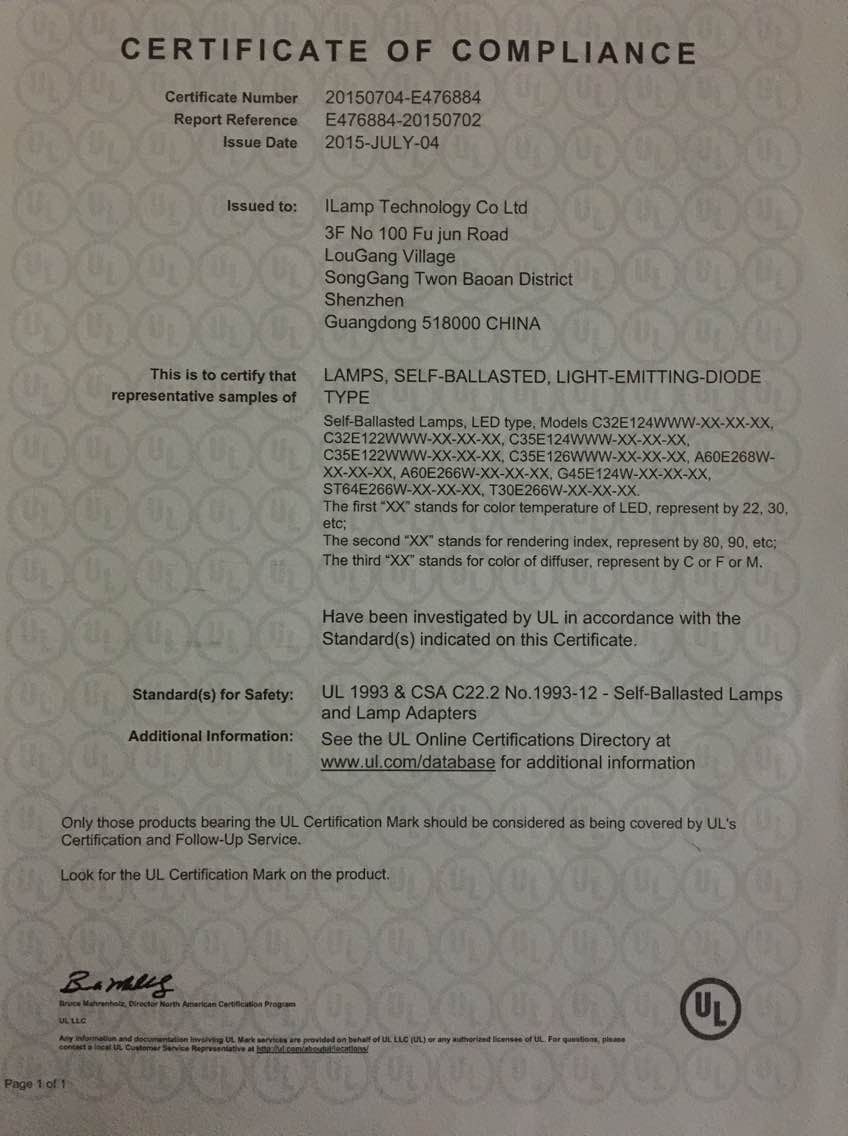
For a 120 V string the question is seasonal or all-year. UL 588 Supplement SD, added on 15 September 2017, covers factory-assembled string lights for year-round outdoor use at up to 120 V, calls for hard-usage cord such as SJW, and, where UL is the laboratory, is taken as a listing under UL product category DGZW with UL's holographic label; an ETL listing to the same standard and supplement uses its own category name and label, and a listing to UL 153 is the alternative route for the same strings. Ask which route the model you are quoting sits on, and read the label on your sample.
Canada
Settle the Canadian side of a WiFi model early. ISED's RSP-100, Issue 12 of August 2019, requires a Canadian representative when the certification applicant's company address is outside Canada; that representative answers ISED enquiries and supplies audit samples, and the certification agreement has to stay in force for as long as the product is on the Canadian market. A Shenzhen factory cannot fill that seat on its own, so decide who does before you order.
European Union
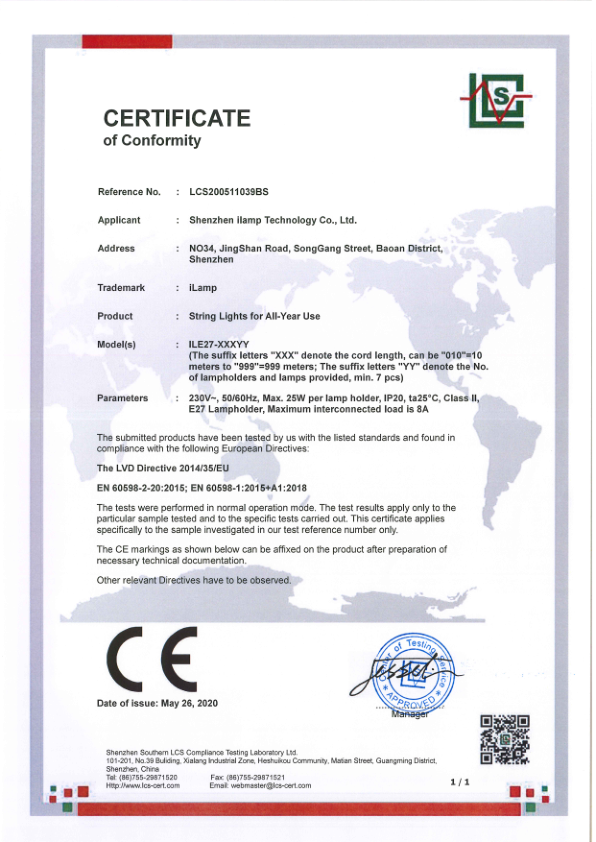
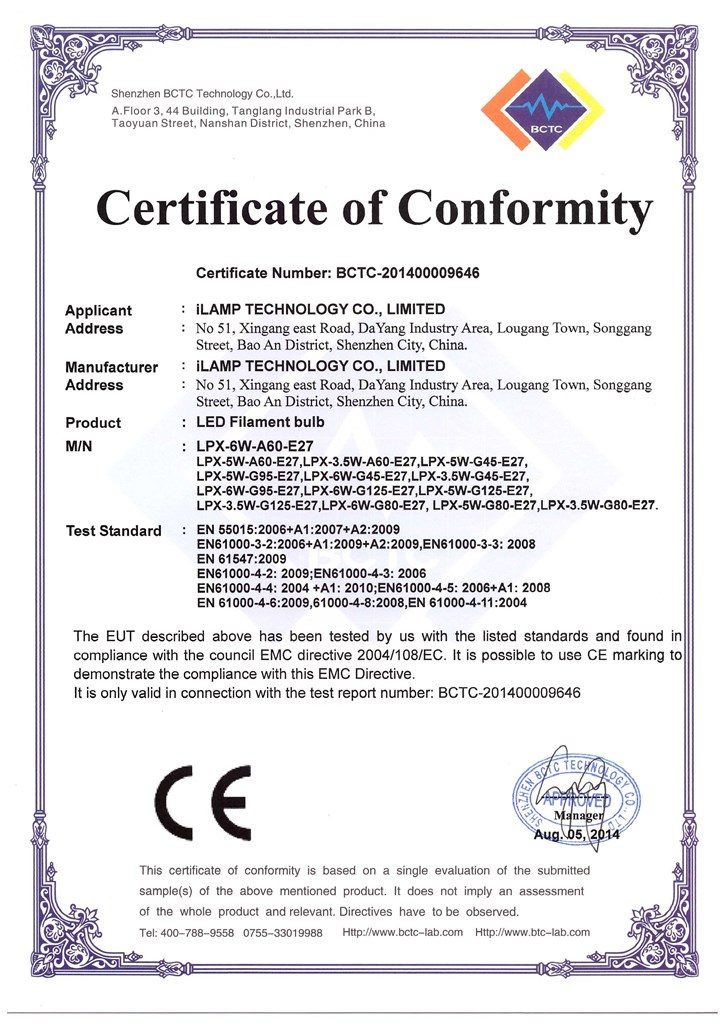
The Low Voltage Directive applies from 50 to 1000 V AC and 75 to 1500 V DC, and no notified body is involved: the maker assesses conformity and signs the declaration itself. Ecodesign Regulation 2019/2020 and energy labelling Regulation 2019/2015 have applied since 1 September 2021, with an A to G label carrying a QR code to the EU register. A light chain is in scope above 60 lm, and where the LEDs cannot be removed without damaging them the chain is itself a light source, so it needs the label and the register entry. The separate luminaire label ended on 25 December 2019.
United Kingdom
Great Britain recognises CE marking indefinitely across 21 product regulations, so UKCA marking is a choice rather than a second project, and a party placing goods on the GB market from outside the UK carries importer duties. A GB declaration names the Electrical Equipment (Safety) Regulations 2016, the Electromagnetic Compatibility Regulations 2016 and, on a radio model, the Radio Equipment Regulations 2017. There is no GB equivalent of the EU register: the supplier keeps the technical documentation itself, produces it on request and holds it for 15 years after the model stops being made, and a GB energy label carries the UK flag.
Australia
The Electrical Equipment Safety System covers household equipment above 50 V AC RMS or 120 V ripple-free DC and below 1000 V AC RMS or 1500 V ripple-free DC. Under AS/NZS 4417.2 a decorative lighting outfit and a portable luminaire are Level 3, the high-risk tier, so each needs a current Certificate of Conformity from a recognised certifier, listed on the national register, before the equipment is registered for sale; a simple portable luminaire is Level 2, which runs on a declaration and a compliance folder. The Responsible Supplier has to be an Australian or New Zealand entity with an ABN or IRD number, so an importer or a brand owner takes that role, not the Shenzhen factory.